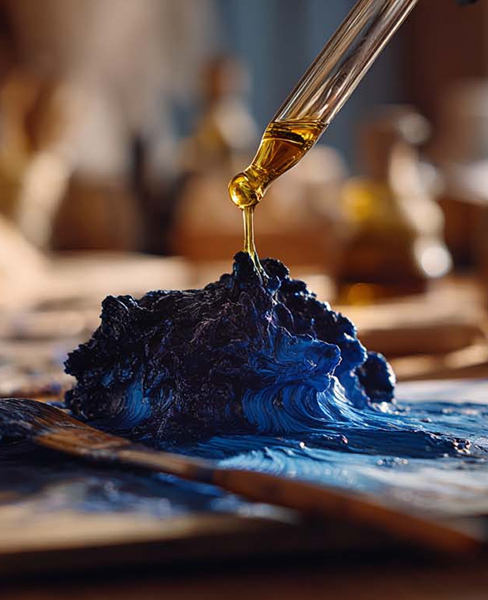
A request lands on your desk — can you take the TiO₂ out — and it arrives wearing one of three different faces. Titanium dioxide alternatives in pearlescent pigments are not one subject, because the three requests do not lead to the same material. This page is about the TiO₂ coating on a mica platelet, not about replacing white pigment in food, paint tinting or sunscreen.
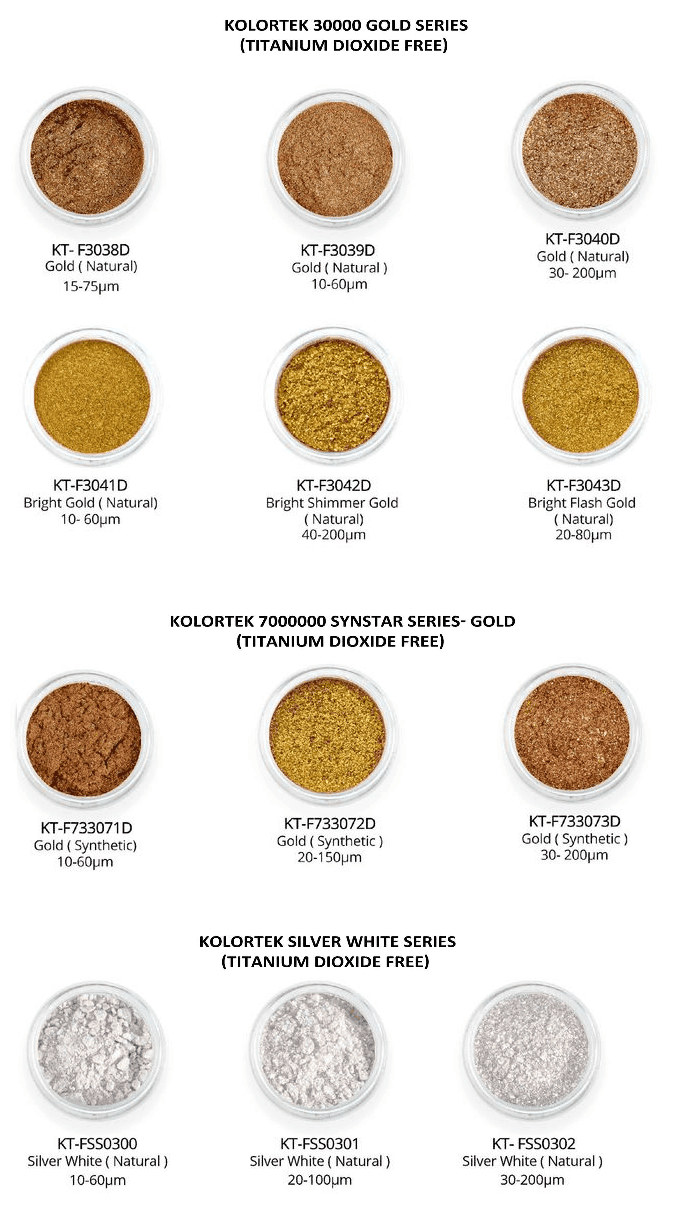
Fig. 1 — A titanium dioxide-free pearlescent range as supplied: gold shades over natural mica and over synthetic mica, and silver white in three size bands. Blue, green and violet interference colours are not part of this range. Product photo.
Before you write the brief, find out which of the three requests you have
Read the message twice. A clean-label request arrives as the brand came back and said no TiO₂; nobody has quoted a regulation, no assessor has raised a question, and the three letters simply need to leave the INCI list. A cosmetics compliance request arrives with a product form attached — loose powder, pressed powder, aerosol — and a question about respirable dust behind it. An industrial optics request arrives from a resin or coating formulator whose drawdown looks flat and whose casting has gone chalky.
The three do not lead to the same answer, and the difference is not bookkeeping. For a clean-label request the answer may be no change of pigment chemistry at all: a coarser band of what you already run, so the fine tail falls away, or a straight conversation about whether the objection is to the substance or to the word. For the compliance request the product form and the measured distribution matter long before the chemistry does. For the industrial request, hold on to this — the goal is the exact opposite of what the cosmetic request wants. You are trying to stop the pigment scattering light back out of the film.
| What the request actually is |
What is really being asked |
What solves it |
What it costs |
Clean label
brand request, no regulation cited |
Remove the three letters from the INCI list. |
A TiO₂-free pigment, or a coarser band of the existing one if the objection is only to the word. |
The cool interference colours, and part of the hiding power. |
Cosmetics compliance
aerosol, loose powder |
Keep the respirable fraction out of the product. |
Product form and size band first; a TiO₂-free pigment only if the form and the distribution cannot get you there. |
Nothing extra, if the band already does the job. |
Industrial optics
casting, clear coating |
Stop the pigment scattering light back out of the film. |
A TiO₂-free pigment, whose lower refractive index lets light into the matrix. |
The same colour restriction — but here it is the point rather than the price. |
We supply both routes, because which one you need follows from which request you have: the TiO₂-free effect pigments described below, and titanium dioxide itself in an anatase cosmetic grade, a silicone-treated cosmetic grade and a rutile cosmetic grade, the last also in 25 kg packing.
One layer, two jobs: interference colour and hiding power
A pearlescent pigment is a platelet substrate carrying one or more thin semi-transparent layers. The colour comes from interference in those layers, and the optical thickness of the layer sets which colour appears [1]. In the overwhelming majority of commercial pearlescent pigments that layer is titanium dioxide.
The same layer does a second job, and the numbers are the whole story. Rutile TiO₂ sits at a refractive index of approximately 2.4–2.7. The natural mica beneath it runs approximately 1.56–1.60; synthetic fluorphlogopite runs approximately 1.52–1.55. That gap is what turns a transparent platelet into something that returns light, and it is also the hiding power — which is why a pearl pigment dropped into a let-down still registers as colour instead of as a tinted clear. That is a coating, not a filler.
So two functions sit on one layer, and that is the difficulty in one sentence. You cannot keep the opacity and drop the substance, and you cannot drop the substance without giving up part of the interference range. The colour also depends on the platelets lying reasonably parallel to the surface before light is returned directionally [1], which is why a change of pigment shows up in the L* reading of a drawdown as much as in the chroma. Call it an engineering trade, because it is not a labelling exercise.
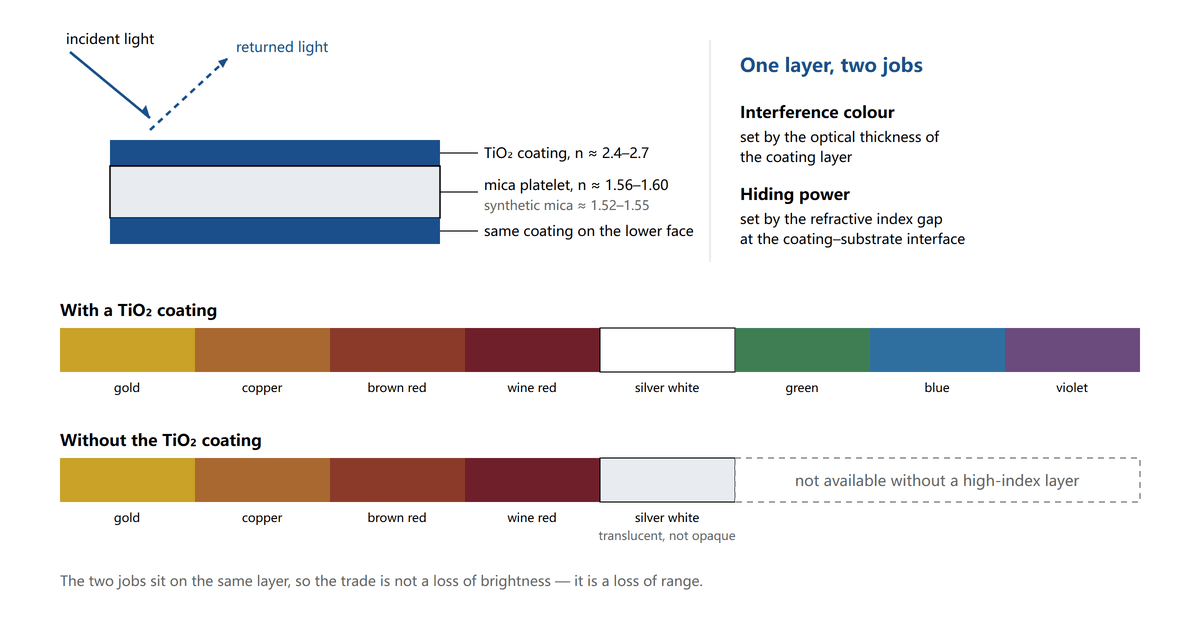
Fig. 2 — In a conventional pearlescent pigment the titanium dioxide layer carries the interference colour and the hiding power at the same time. Removing the layer removes both, which is why the trade is not a change of brightness but a change of range. (illustrative)
What does the regulation actually cover, and what does it leave alone?
The words in the regulation are narrower than the words in the request. Commission Regulation (EU) 2021/850 of 26 May 2021, the third CMR Omnibus regulation, came into force on 15 June 2021 and applied from 1 October 2021, giving effect to Delegated Regulation (EU) 2020/217. The criterion it introduces: titanium dioxide in powder form, containing 1 % or more of particles with an aerodynamic diameter of 10 µm or less, is classified as a Category 2 carcinogen by inhalation [2]. Both conditions have to be met. The substance on its own does not meet them.
Annex III then carries the limits that actually bind a formulator, and these are the figures to have on screen when the brand owner asks: face powders up to 25 %; hair aerosol sprays up to 1.4 % for the general consumer and 1.1 % for professional use; and for other products, no use permitted in applications that may lead to lung exposure by inhalation [2].
What the classification does not do is ban the material. Titanium dioxide is still permitted as a colorant: CI 77891 remains on Annex IV, entry 143, subject to the purity criteria of Commission Directive 95/45/EC — the E 171 standard [2][4]. A cosmetic may use only colorants listed in Annex IV, and the safety report behind that choice is signed by a qualified safety assessor under Article 10 [4].
In a pearlescent pigment, though, the TiO₂ is not sitting there as free pigmentary powder. It is bound inside the pigment structure as a coating on the platelet. What produces a respirable fraction is the breakage of platelets and the fine tail of the size distribution — not the word on the label. If the substrate is mica and the market is the United States, the substrate has its own specification to meet: 21 CFR 73.1496 requires mica to pass 100 % through a 100-mesh sieve. It also specifies loss on ignition at 600–650 °C of not more than 2 %, lead not more than 20 ppm, arsenic not more than 3 ppm and mercury not more than 1 ppm [3]. Mica is permanently listed and exempt from batch certification.
The conclusion to carry forward: the variable that decides whether a formulation is in scope is the particle size distribution of the material as handled, assessed against the aerodynamic criterion and the product form, not the word "free" on the label.
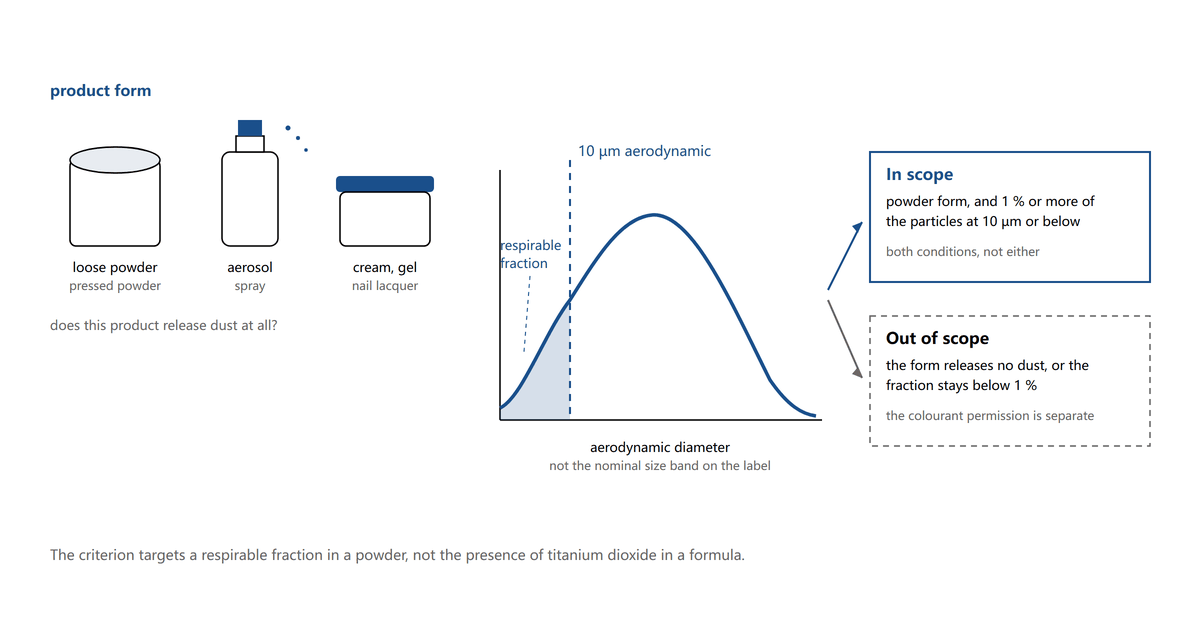
Fig. 3 — The criterion is about respirable particles, not about the presence of titanium dioxide. The same pigment falls inside or outside the scope depending on how much of its size distribution sits below the aerodynamic diameter threshold, and on whether the product form releases dust at all. (illustrative)
If the titanium dioxide comes out, here is the colour you keep
Silver white survives without TiO₂, in three size bands: KT-SS0300 at 10–60 µm, KT-SS0301 (flash) at 20–100 µm and KT-SS0302 (shimmer) at 30–200 µm. What it does not do is read as an opaque white. It reads as a translucent silver, and the reason is the refractive index gap — nothing else applied as a thin layer on mica reaches 2.4–2.7, so less light is returned and the hiding power drops with it. If your drawdown was built on an opaque silver, expect to rebuild it.
Warm gold is where the TiO₂-free range is at its fullest. Iron oxide applied over natural mica carries the colour, and six gold shades run across the size bands: KT-3038D at 15–75 µm, KT-3039D at 10–60 µm, KT-3040D at 30–200 µm, KT-3041D at 10–60 µm, KT-3042D at 40–200 µm and KT-3043D at 20–80 µm. On a synthetic mica substrate there are three: KT-733071D at 10–60 µm, KT-733072D at 20–150 µm and KT-733073D at 30–200 µm. If the brief is warm and metallic, that is the warm end of the range, where the colour choice is widest.
The cool interference colours are the part that goes away. Blue, green and violet interference depend on a high-index layer of controlled optical thickness, and inside the TiO₂-free range those are not available. A brief that specifies a blue interference over black does not get there by adjusting a size band.
Before you redraw the standard, check which colour bands the range actually covers against your own target — the pearls for cosmetics colour compilation sets out the cosmetic pearl bands against the rest of the book. A supplier can tell you what the range reaches. Whether that range covers your brief is your call, made against your own colour standard, on your own substrate, in your own let-down.
When the reason is light transmission, the same label means the opposite thing
The second reader has no compliance question at all. In a casting resin, a gel coat or a clear industrial film, the pigment's own hiding power is the defect: it stops light travelling into the matrix and returning from depth, so the casting reads grey and shallow instead of deep, and the paste is too opaque to see into. Removing the TiO₂ layer is how that depth comes back, because a lower refractive index lets light into the film rather than bouncing it straight back off the surface.
The mechanism difference fits in a sentence: in a cosmetic the platelet is being asked to colour a surface, and in a casting it is being asked to interact with light inside a volume. The depth that comes back when the opacifier goes, illustrated by KT-95625 is the whole point of the exercise here, not a side effect of it. There is no safety argument in this half of the article, and dressing one up would only confuse a decision that is purely about optics.
The particle size distribution: D10, D50, D90 and how to ask for them
Put three things on the specification sheet and in the message to a supplier: the product form — loose powder, pressed powder, aerosol, cream, casting — the size band as supplied, and the distribution as measured, D10, D50 and D90. The first helps establish whether the product releases dust at all. The second is what the catalogue quotes. The third summarises the measured distribution and supports comparison across suppliers when the measurement method and distribution basis match. Those percentiles alone do not fully describe the fine tail or establish the fraction below an aerodynamic diameter threshold.
A nominal band is an envelope, not a distribution. Two suppliers can both quote 10–60 µm and ship material whose fine tails sit in different places; the band tells you nothing about how much of the powder sits below a given aerodynamic diameter. Ask for the measurement method and distribution basis as well, and let the safety assessor identify what evidence is needed to assess the aerodynamic criterion. If you are still working out how the bands are organised, start with choosing a size band before choosing a chemistry. A technical data sheet, a material safety data sheet and a certificate of analysis carrying the distribution come on request for the grade and the market in question; ISO 9001:2015 is held, and documentation for any other scheme is provided on request.
Then the limit, plainly. A pigment supplier can speak to the pigment — its chemistry, its coating, its size band and the documentation that travels with it. A supplier cannot decide whether a given formulation falls inside the scope of an Annex III entry. The safety report carries a qualified safety assessor's signature under Article 10 [4]. The scope assessment needs evidence relevant to the aerodynamic criterion and a named product form, not just a label or a set of particle size percentiles.
FAQ
Is titanium dioxide banned in cosmetics in the EU?
No. It is classified as a Category 2 carcinogen by inhalation where it is a powder containing 1 % or more of particles with an aerodynamic diameter of 10 µm or less, and it carries Annex III restrictions on face powders and hair aerosols [2]. As a colorant, CI 77891 remains permitted on Annex IV, entry 143, subject to the purity criteria of Commission Directive 95/45/EC [4].
Can you make a blue or green pearl pigment without titanium dioxide?
Within the TiO₂-free range described here, no. Blue, green and violet interference depend on a high-index layer of controlled optical thickness, and those colours are not available without it. Silver white in three size bands and the gold shades over natural or synthetic mica are.
Does a TiO₂-free pearl pigment have lower opacity?
Yes, and the reason is optical rather than a matter of formulation: no alternative coating layer reaches the refractive index of rutile TiO₂ at approximately 2.4–2.7, so less light is returned and hiding power drops. In a cosmetic that usually reads as a translucent finish rather than an opaque one.
How do I know whether my loose powder is in scope?
From evidence about the particle size distribution of the material as you handle it and the product form, not from the label. Ask for D10, D50 and D90, together with the measurement method and distribution basis, and pass them to your safety assessor with the product form — loose powder, pressed powder or aerosol. Those percentiles alone do not establish the aerodynamic fraction; the assessor determines what further evidence is needed to decide scope.
References
- Maile, F. J.; Pfaff, G.; Reynders, P. "Effect pigments—past, present and future." Progress in Organic Coatings, 2005, 54(3), 150–163. DOI: 10.1016/j.porgcoat.2005.07.003
- Commission Regulation (EU) 2021/850 of 26 May 2021 amending the conditions of use and the labelling of titanium dioxide in cosmetic products. Official Journal of the European Union. https://eur-lex.europa.eu/eli/reg/2021/850
- 21 CFR 73.1496 — Mica. Code of Federal Regulations, Title 21, Part 73, Subpart B. https://www.ecfr.gov/current/title-21/chapter-I/subchapter-A/part-73/subpart-B/section-73.1496
- Regulation (EC) No 1223/2009 of the European Parliament and of the Council on cosmetic products. Official Journal of the European Union. https://eur-lex.europa.eu/eli/reg/2009/1223/oj

 Русский
 English
 Français
 Deutsch
 Español
 Português